The rapture is before the tribulation because nothing in this dispensation of the mystery is prophesied.
Ephesians 3:8,9
show us that: To me, who am less than the least of all the saints, this grace was given, that I should preach among the Gentiles the unsearchable riches of Christ, 9 and to make all see what is the dispensation of the mystery, which has been hidden from ages in God who created all things through Jesus Christ.
That is what I call the nature of the mystery.
After the rapture, the tribulation will come next.
Israel was identified as the people of the tribulation by Daniel. Dan 9:24
“Seventy weeks are determined for your people and for your holy city, to finish the transgression, to make an end of sins, to make reconciliation for iniquity, to bring in everlasting righteousness, to seal up vision and prophecy, and to anoint the Most Holy.
Dan 10:14
Now I have come to make you understand what will happen to your people in the latter days, for the vision refers to many days yet to come.
Our Lord Jesus Christ mentioned Daniel’s abomination of desolation (Dan 9:27; 11:31) in the future tribulation’s setting (Mat 24:15-21).
One purpose of the tribulation will be to purify Israel for her kingdom reign (Dan 9:24; Zec 13:9).
That’s why Jeremiah 30:7 says the tribulation is precisely called a time of tribulation for Jacob.
Since the mystery, The Body of Christ, has nothing to do with Israel, the tribulation, which is specifically designated for Israel, is irrelevant to the church which is His body.
The nature of the mystery shows us that the body of Christ is never referred to in prophecy prior to Paul’s conversion. Therefore, here are the conclusions I will attempt to prove about the events that occur and their relation to the tribulation and the millennium. They are:
Prophecy about the people in the tribulation could not refer to the body of Christ.
Prophecy about the day of the Lord could not apply to the body of Christ.
Prophecy about the people under the wrath of God could not apply to the body of Christ.
Therefore, the rapture, since it only applies to the body of Christ, must take place prior to the time of Jacob’s trouble, the tribulation, which follows the rapture for the next seven years.
The great and awesome day of the Lord will follow the tribulation.
This is what is normally called the second coming. I will quote two passages to show this.
Acts 2:20
“The sun shall be turned into darkness and the moon into blood before the coming of the great and awesome day of the LORD.”
That was not part of the Mystery that was later given to Paul.
Mat 24:29,30
Immediately after the tribulation of those days the sun will be darkened, and the moon will not give its light; the stars will fall from heaven, and the powers of the heavens will be shaken. 30 Then the sign of the Son of Man will appear in heaven, and then all the tribes of the earth will mourn, and they will see the Son of Man coming on the clouds of heaven with power and great glory.
Again, that was not part of the Mystery that was later given to Paul.
Next, the judgment of the nations takes place:
Mat 25:31,32
When the Son of Man comes in His glory, and all the holy angels with Him, then He will sit on the throne of His glory. 32 All the nations will be gathered before Him, and He will separate them one from another, as a shepherd divides his sheep from the goats.
The millennial reign of Christ begins after that judgment:
Rev 20:4
And I saw thrones, and they sat on them, and judgment was committed to them. Then I saw the souls of those who had been beheaded for their witness to Jesus and for the word of God, who had not worshiped the beast or his image, and had not received his mark on their foreheads or on their hands. And they lived and reigned with Christ for a thousand years.
Then Satan is loosed after the thousand year reign of Christ.
Rev 20:7-9
Now when the thousand years have expired, Satan will be released from his prison 8 and will go out to deceive the nations which are in the four corners of the earth, Gog and Magog, to gather them together to battle, whose number is as the sand of the sea. 9 They went up on the breadth of the earth and surrounded the camp of the saints and the beloved city. And fire came down from God out of heaven and devoured them.
Then the great white throne judgment takes place.
Rev 20:11-15
Then I saw a great white throne and Him who sat on it, from whose face the earth and the heaven fled away. And there was found no place for them. 12 And I saw the dead, small and great, standing before God, and books were opened. And another book was opened, which is the Book of Life. And the dead were judged according to their works, by the things which were written in the books. 13 The sea gave up the dead who were in it, and Death and Hades delivered up the dead who were in them. And they were judged, each one according to his works. 14 Then Death and Hades were cast into the lake of fire. This is the second death. 15 And anyone not found written in the Book of Life was cast into the lake of fire.
Then the new heavens and earth are established. And they reign forever.
Rev 21:1,3,27; 22:5
Now I saw a new heaven and a new earth, for the first heaven and the first earth had passed away. . . . 3 Behold, the tabernacle of God is with men, and He will dwell with them, and they shall be His people. God Himself will be with them and be their God. . . . 27 only those who are written in the Lamb’s Book of Life. 22:5 And they shall reign forever and ever
Much of the prophecy in Daniel 11 has already happened. Some of it is still in the future. This chart compares historical events with the prophecy so we can tell what are past, and what are future events.
11:2-4, And now I will tell you the truth: Behold, three more kings will arise in Persia, and the fourth shall be far richer than them all; by his strength, through his riches, he shall stir up all against the kingdom of Greece. Then a mighty king shall arise, who shall rule with great dominion and do according to his will. And when he has arisen, his kingdom shall be broken and divided toward the four winds of heaven, but not to his posterity, nor according to the dominion which he ruled; for his kingdom shall be plucked up and go to others beside these.
11:6, After some years they shall make an alliance, and the daughter of the king of the south shall come to the king of the north to make peace; but she shall not retain the strength of her arm, and he and his offspring shall not endure; but she shall be given up, and her attendants, her child, and he who got possession of her.
Ptolemy II’s daughter, Berenice, married the north king Antiochus II Theos bringing a short lived alliance. Berenice’s children were to be the new heirs to the throne. But Antiochus left later returned to his first wife and Berenice and her children were all killed.
11:7, In those times a branch from her roots shall arise in his place; he shall come against the army and fortress of the king of the north, and he shall deal with them and shall prevail.
Berenice’s brother (the branch), Ptolemy III (already mentioned as the ‘strong prince’) waged a war against the northern king Seleucus, which was known as the 3rd Syrian War (245-241 BCE), and won taking the capital at Antioch.
11:8, He shall also carry off to Egypt their gods with their molten images and with their precious vessels of silver and of gold; and for some years he shall refrain from attacking the king of the north.
11:10, His sons shall wage war and assemble a multitude of great forces, which shall come on and overflow and pass through, and again carry the war as far as his fortress.
Seleucus II’s son, Antiochus III the Great, took his forces all the way to Ptolemais, retaking all the territories lost to Ptolemy III, who was now succeeded by Ptolemy IV Philopator.
11:11-13, The the king of the south, moved with anger, shall come out and fight with the king of the north; and he shall raise a great multitude, but it shall be given into his hand. And when the multitude is taken, his heart shall be exalted, and he shall cast down tens of thousands, but he shall not prevail. For the king of the north shall again rise a multitude, greater than the former; and after some years he shall come on with a great army and abundant supplies.
11:14, In those days many shall rise up against the king of the south; and the men of violence among your own people shall lift themselves up in order to fulfill the vision; but they shall fail.
This could refer to an account found in the orthodox book of 3 Maccabees.Ptolemy IV went to Jerusalem to make a sacrifice and attempted to enter the Temple but was prevented. He hated the jews (Daniel’s own people) for this and attempted to kill many of them.
(NOTE: The story is considered legendary by some, however there could be some truth to the book?)
11:15-16, Then the king of the north shall come and throw up siege-works, and take a well-fortified city. And the forces of the south shall not stand, or even his picked troops, for there shall be no strength to stand. But he who comes against him shall do according to his own will, and none shall stand before him; and he shall stand in the glorious land, and all of it shall be in his power.
Antiochus III was now ready to take a bite out of the south. The death of Ptolemy IV shown opportunity to attack Egypt at Gaza (the well fortified City).Then he turned against the jews in Judea (the glorious land) and won the land.
11:17-18, He shall set his face to come with the strength of his whole kingdom, and he shall bring terms of peace and perform them. He shall give him the daughter of women to destroy the kingdom; but it shall not stand or be to his advantage. Afterwards he shall turn his face to the coastlands, and shall take many of them; but a commander shall put an end to his insolence; indeed he shall turn his insolence back on him.
Rome won which resulted in Antiochus loosing newly claimed land.
11:19, Then he shall turn his face back toward the fortresses of his own land; but he shall stumble and fall, and shall not be found.
Antiochus then turn back to his own land in Iran. Antiochus mounted a fresh expedition to the east in Luristan, where he died in an attempt to rob a temple at Elymaïs, Persia, in 187 BC.
11:20, Then shall arise in his place one who shall send an exactor of tribute through the glory of the kingdom; but within a few days he shall be broken, neither in anger nor in battle.
Antiochus left The Seleucid kingdom to his son Seleucus IV Philopator.The war with Rome left his kingdom in financial stress. In turn he was assassinated (broken, neither in anger nor in battle) by his minister, Heliodorus, because of his policies. 2 Maccabees 3:1-28 reports Seleucus tried to take treasures from the temple in Jerusalem, possibly the meaning of “exactor of tribute.”
11:21-24, In his place shall arise a contemptible person to whom royal majesty has not been given; he shall come in without warning and obtain the kingdom by flatteries.
Armies shall be utterly swept away before him and broken, and the prince of the covenant also. And from the time that an alliance is made with him he shall act deceitfully; and shall become strong with a small people.
Without warning he shall come into the richest parts of the province; and he shall do what neither his fathers nor his fathers’ fathers have done, scattering among them plunder, spoil and goods. He shall devise plans against strongholds, but only for a time.
Verses 21-24 are a brief account of Antiochus IV, the verses after 25 go into more detail.The throne of Seleucus had no heir, because his son, Demetrius, was prisoner in Rome. He was a prisoner in exchange for Antiochus IV, son of the previous king Antiochus III. Antiochus IV took advantage of the empty throne and established himself as king.
Antiochus lead a few campaigns against Egypt, and warred with Israel(the prince of the covenant) and other countries through his reign. He was able to avid Roman Intervention By leaving the King of Egypt on the throne, but only as a puppet king. He later invaded Egypt again, under the rule of Ptolemy VI Philometor. After leaving Egypt, he took Israel which was under Egyptian rule.
Israel was treated harsher by Antiochus than any king before. He taxed them, literally, to death, then killed them some more. He striped their freedom of religion too.
11:25-26, And he shall stir up his power and his courage against the king of the south with a great army; and the king of the south shall wage war with an exceedingly great and mighty army; but he shall not stand, for plots shall be devised against him. Even those who eat his rich food shall be his undoing; his army shall be swept away, and many shall fall down slain.
And as for the two kings, their minds shall be bent on mischief; they shall speak lies at the same table, but to no avail; for the end is yet to be at the time appointed.
Verses 21-24 were an overview, now we go into more detail.Antiochus IV invades Egypt for his first time. He captures most of it. Antiochus leaves Egypt with it’s king, Ptolemy VI, on the throne, as a part of an agreement; Ptolemy is to be a puppet king to Antiochus.
Ptolemy was eventually driven off the throne by his members of his own family, where he would go to Rome for help.
The two kings could refer to Ptolemy and his younger brother who ruled jointly.
Birth of Hanukkah
11:28, And he shall return to his land with great substance, but his heart shall be set against the holy covenant. And he shall work his will, and return to his own land.
Antiochus IV returned to his kingdom after his victory, passing through Israel as he went north. He wanted to Hellenize the Jews there, so his heart was “ against the holy covenant.” He passed laws making it illegal to worship God and replaced him with Zeus.
11:29-30a, At this time appointed he shall return into the south; but it shall not be this time as before. The ships of the Kittim shall come against him, and he shall be afraid and withdraw”.
Antiochus IV returned to Egypt again, the outcast Ptolemy VI was ahead of him this time. Having told Rome(Kitttim, west of Israel) what Antiochus was up to, Rome sent her ships after Antiochus and found him invading. Having almost won the war, he was caught by the Roman,Gaius Popillius Laenas…
11:30b-31, and [he] shall turn back and be enraged and take action against the holy covenant. He shall turn back and give heed to those who forsake the holy covenant. Forces from him shall appear and profane the temple and fortress, and shall take away the continual burnt offering. And they shall set up the abomination that makes desolation.
Being threatened, he ran and withdrew from Egypt. He was furious and turned his wrath on the Jewish nation of Israel.He wanted so bad to make the Jews into Greeks he killed anyone who resisted Hellenization, built a statue of Zeus at the temple for worship, and sacrificed a pig on the alter of the holy temple. To a Jew, pig sacrifice was a very unholy thing. This was the “abomination that makes desolation.“
11:32-33, He shall seduce with flattery those who violate the covenant; but the people who know their God shall stand firm and take action. And those among the people who are wise shall make many understand, though they shall fall by the sword and flame, by captivity and plunder, for some days.
Whomever worships Zeus was safe from his hand, but those who didn’t were severely persecuted. They held out for some years.
11:34-35, When they fall, they shall receive a little help. And many shall join themselves to them with flattery; and some of those who are wise shall fall, to refine and to cleanse them and to make them white, until the time of the end, for it is yet for the time appointed.
Antiochus died suddenly after he had his way with Israel. So God’s people prevailed and the Temple restored. The final stand against Antiochus marks the beginning of the Jewish holiday Hanukkah.
What never happened (or is yet to happen)
36-44 “Then the king shall do according to his own will: he shall exalt and magnify himself above every god, shall speak blasphemies against the God of gods, and shall prosper till the wrath has been accomplished; for what has been determined shall be done. 37 He shall regard neither the God of his fathers nor the desire of women, nor regard any god; for he shall exalt himself above them all. 38 But in their place he shall honor a god of fortresses; and a god which his fathers did not know he shall honor with gold and silver, with precious stones and pleasant things. 39 Thus he shall act against the strongest fortresses with a foreign god, which he shall acknowledge, and advance its glory; and he shall cause them to rule over many, and divide the land for gain.40 “At the time of the end the king of the South shall attack him; and the king of the North shall come against him like a whirlwind, with chariots, horsemen, and with many ships; and he shall enter the countries, overwhelm them, and pass through. 41 He shall also enter the Glorious Land, and many countries shall be overthrown; but these shall escape from his hand: Edom, Moab, and the prominent people of Ammon. 42 He shall stretch out his hand against the countries, and the land of Egypt shall not escape. 43 He shall have power over the treasures of gold and silver, and over all the precious things of Egypt; also the Libyans and Ethiopians shall follow at his heels. 44 But news from the east and the north shall trouble him; therefore he shall go out with great fury to destroy and annihilate many. 45 And he shall plant the tents of his palace between the seas and the glorious holy mountain; yet he shall come to his end, and no one will help him.
The Verses following 36 cannot be linked with actual historical events. They tell of the last days(the time of the end) where the northern king will position himself as a god to be worshiped, and will be attacked by the Southern King.After the attack, the Northern King will dominate and overtake many countries. Yet his time will also come to an end.
So now the question remains, why did this not happen? Why does it seem to be reserved for a future event?
The answer may be confusing at first, but Paul speaks of “the dispensation of the mystery” a time which was never prophesied. We are living in it now. It is an unforetold gap in prophetic history, put here by God to save the Gentiles until Israel is ready.
If you want to read about what actually happened after Hanukkah, click here. You scroll to Wikipedia’s timeline at the bottom of the page to see what happens to Antiochus.
In short the Romans crush the empire after his son takes the throne to rule for the next few hundred years.
Many shows on TV and Radio try to tie prophecies from the Bible into today’s current events. And every time they try, they end up wrong. Why is this? In short, this current age was never prophesied about, rendering it impossible to tie into most prophecy.
We have established that we live in a dispensation/era of salvation through grace alone. Only Paul’s message brings to light things about this dispensation. Not only are we free from the law of Moses, saved by grace alone, we also live in a “mystery.â€
Paul refers to this dispensation as the mystery because nothing about it has ever been to any prophet pryer to Paul. Only with Paul do we find details about this grace era.
To me (Paul), who am less than the least of all the saints, this grace was given, that I should preach among the Gentiles the unsearchable riches of Christ, 9 and to make all see what is the fellowship of the mystery, which from the beginning of the ages has been hidden in God who created all things through Jesus Christ;10 to the intent that now the manifold wisdom of God might be made known by the church to the principalities and powers in the heavenly places, 11 according to the eternal purpose which He accomplished in Christ Jesus our Lord, 12 in whom we have boldness and access with confidence through faith in Him.
So many try to see events of today as fulfillment of prophecy. But they are wasting their time, because this entire era was hidden from all prophets pryer to Paul.
Think of today’s age as a gap in overall prophecy time-line. A gap that will end one day, and normal operation will resume. We do not know when this will be, but Paul gives us this hint:
For I do not desire, brethren, that you should be ignorant of this mystery, lest you should be wise in your own opinion, that blindness in part has happened to Israel until the fullness of the Gentiles has come in.
Once the fullness os the Gentiles is reached, God will turn to Israel again with his original plan to have an earthly kingdom through them. When will this happen? What is the fulness of the Gentiles?
No one knows exactly. I think it refers to the time the Gentiles inspire Israel to turn to Christ. That after all is why the Gentiles and the era of Grace exists, to provoke Israel to be jealous that favor has fallen to the rest of the world when it should be theirs as well.
11 I say then, have they stumbled that they should fall? Certainly not! But through their fall, to provoke them to jealousy, salvation has come to the Gentiles. 12 Now if their fall is riches for the world, and their failure riches for the Gentiles, how much more their fullness!
Today we are under the mystery. Nothing about it was ever revealed to anyone else but Paul, and he was the sole messenger for it. The other Apostles, John, Peter, James, were messengers to Israel, and did not preach or prophecy according to it (Galatians 2).
The books of Revelation, Daniel, or any of the other Prophets had nothing to say about this era because it was kept secret from everyone until Paul.
When you hear dooms day sayers, know they have no Biblical basis for their message, at least until the fulness of the gentiles happens.
Imagine that you are in Heaven and are finally face to face with many of the characters of the Bible. Who do you want to meet? Maybe you would try to see St. Peter, or St. Paul, or one of the other characters you heard about in church.
In heaven, you’ll have the chance to meet them all, but what will you do when you meet Obadiah?
If you are like many Christians, perhaps the meeting will go like this:
“Hi, I’m Obadiah, how are you?”
“Hi, it is nice to meet you…” you answer, a little confused as to who this guy is. You start thinking back on sermons in church, trying to remember if the preacher ever mentioned him.
Obadiah will say, “I was wondering… did you like my book?”
You answer, “Your book?”
“Yeah, my book. How did you like my book? It was in the Bible, remember?”
“Oh, I am sorry,” you answer, unable to remember, “Refresh my memory, Ob-a…diah, what book did you write?”
“When I was on Earth, I was the prophet who wrote the book Obadiah. I was so excited that it made it in the Bible! Didn’t you read my book?”
“Forgive me Obadiah, but when I was on earth, I was so busy. I never had time to read your book.”
“You didn’t have time to read my book?” Obadiah answers, looking very confused.
Awkward silence follows, and finally he says, “Ok. Well, maybe you can read it now? I happen to have a copy right here.”
Out of his back pocket he hands you a single piece of paper titled, “Obadiah”. It only has twenty-one verses.
“Please let me know when you have time to read it,” he says as he smiles and walks away.
There is so much more in the Bible than you’ll ever hear in church. The best way to learn is to read it for yourself. Treat it like any other book, start on the first page and keep reading straight through.
If you are confused, don’t stop. Consider the confusion a part of a developing plot that has yet to reveal all of the answers. The confusion may be cleared up on the next page or even the next book.
We do not all have to be Bible experts. Anyone who reads to the end of the Bible knows that questions still arise. Having a perfect understanding may not be possible until we are in Heaven.
What really matters is that we allow the parts we can understand to bless us. Find out what those blessings are by reading the Bible for yourself.
Remember, Obadiah is not the only person who wants you to read his book. God is also hoping you’ll read His. It is His gift to us.
In this article I would like to submit a simple logical proof that we do in fact have a free will. In so doing it is my intention to also falsify any form of what has become known in recent months as the “Settled View”, which includes both Calvinism and Arminianism as well as any other perhaps unnamed theological system which teaches, whether it be simply in the mind of God or in actual fact, that the future is settled in any way or by any means.
Because such arguments have been bantered around for centuries and because many are somewhat familiar with them and have thus formed preconceived notions as to the flaws in such arguments, I feel it is important at the outset to point out that the argument that I am making here isn’t that God causes things by knowing them. Whether or not God knowing something causes that thing is an altogether separate issue that has to do with God being the first cause of all that happens and if God knew it and didn’t cause it then who did, etc. But the point is that I do not make any such argument in this article, nor does the argument presented here have any such notion as one of its underlying premises.
My argument has simply to do with the definition of free will and the logical implications of a future act being known (i.e. settled), or even knowable for that matter. For clarities sake I offer the argument in the form of a logical syllogism and I remind the reader that if we are to have a rational theology then we must not be afraid to accept the conclusions of sound reason.
We start with the definition of a couple of terms:
Premise 1a: Free will is defined as having the ability, by an act of that will, to do or do otherwise.
Premise 2a: If something is known, it is apprehended with certainty.
Premise 3a: If a future action is known by whatever means then there is no ability to do other than what is known or else it could not be said to have been known.
Conclusion A: If the future is known, by whatever means, then I do not have free will.
Now, that only gets us to an “If then” statement. It does not answer for us whether we do or do not have free will nor does it answer whether or not God knows the future. All it does is prove that IF God does know the future THEN we are not free. To prove we do have free will we have to take a few more steps:
Premise 1b(Conclusion A): If the future is known, by whatever means, then I do not have free will.
Premise 2b: Love, by definition, is a choice. Love must be volitional. Love must be a product of a free will. (Whichever way you want to put it, these are all equivalent statements.)
Conclusion B: If I do not have free will then I cannot love.
Conclusion B is another “if then” statement, which then yields the following…
Premise 1c(Conclusion A): If the future is known, by whatever means, then I do not have free will.
Premise 2c(Conclusion B): If I do not have free will then I cannot love.
Premise 3c: The Christian faith demands the ability to love. Or put in more logically formal terms: Love is a necessary condition of the Christian faith.
Conclusion C: Either I have free will or the law of non-contradiction rationally falsifies Christianity.
And finally…
Premise 1d (Conclusion C): Either I have free will or the law of non-contradictionrationally falsifies Christianity.
Premise 2d: Christianity is true because of the rational impossibility of the contrary. (As this article is aimed primarily at Christians, I will not bother to establish this premise here. But for those of you who are interested you can get a taste for it by reading THIS.)
Conclusion D: I do have free will.
Conclusion E (From Conclusions A and D): The future is not known.
Now, that’s the whole argument in a nutshell. I won’t bother with putting it into a syllogism but it is important to point out, and I will simply trust that the reader is able to see intuitively, that if the future is not known by God, it certainly cannot have been predestined by Him either and thus this argument falsifies the Calvinist version of the Settled View and much as it does the Arminian and any other version of the Settled View that one might be able to conjure up and that therefore the Open View must be true because of the rational impossibility of the contrary (i.e. because all other options have been rationally falsified).
Some of you will instinctively begin to quote Scripture in an attempt to refute the conclusions offered but I remind you again that our theology must be BOTH biblical and of sound reason. Scripture does not trump sound reason, nor reason the Scripture. If both are true then both must be in agreement with each other. We know that Scripture is true and so if my reasoning is in error then whatever Biblical argument is offered in refutation of it must be presented in the context of addressing a specific premise in this argument prior to ‘Conclusion C’ because if Christianity is falsified then so is the Bible and thus any Biblical argument offered would fail on that single point alone.
It is my contention and firm belief that the Bible must be read in the context of this free will paradigm in order to make any rational sense whatsoever, and so you can expect that I will reject any interpretation of the Bible that contradicts this line of reasoning (without this line of reasoning having first been demonstrated to be fallacious), in favor of an interpretation that maintains this rationally coherent paradigm.
The Bible is true and therefore it is rational; any irrational interpretation must and will therefore be rejected as false. I would pray that you adopt this same attitude toward the Scripture for yourself.
May God bless you as you grow in His wisdom and grace.
Resting in Him,
Clete Pfeiffer
P.S.
This will be my first article submitted to this website and so let me start off by saying thank you to Pat for giving me the opportunity and for doing all the work that is necessary in putting together a website of this nature. It is my hope that this and whatever other contributions I make to this site will work for the furtherance of the Gospel of the Grace of God and to the edification of the Body of Christ in its understanding of the Word of God rightly divided.
There is no scripture anywhere in the Bible that tells us that God knows all of the future. There is no doubt that God does know some future events, but does he know all of it? Most importantly, did he know Adam and Eve would fall? It may be shocking, but it is true. There is no verse that tells us that God knows all of the future. Some to show some future knowledge, yet we take some to mean all. Why do we conclude that he knows all of the future? In part, because of tradition, but we also use logical reasoning.
This equation shows the logical thought process used to prove God has 100% future knowledge:
“A” knows all of the future because “A” predicted that “B” would happen with accuracy.
“A” = ‘God’, “B” = ‘some bible prophecy’, such as ‘Peter denying Christ’.
So with this logical thinking, God knows all of the future because God predicted Peter would deny Christ. But is this really true? Does predicting a future event mean someone knows all of the future?
If you substitute “A” with an actual person and “B” with an event they predicted, the conclusion is not they knew all of the future.
“A” = My mother
“B” = Get married
My mother predicted that one day I would get married. Therefore my mother knows the all of future.
Did it happen? Yes. Therefore “A” (mom) knows all of the future. This logic fails big time. But there are other logical conclusions that try to prove God’s unending future knowledge.
If the we can repeatedly show someone knows future events it is more likely or true that that person knows all of the future.
“A” knows the future because of the large number of accurate predictions.
Thus it is said that because God predicted Peter and Judas, the crucifixion, and the book or revelations, thus God knows the all of future.
But, again, my mom predicted that one day I would go to high school, that I would have a broken heart from a girl turning me down, that one day I would learn to drive a car, and that I would go to the prom and graduate. She said I would go to college, despite my non-willingness to go. And to this day she thinks me and my wife will have children. Therefore, mom knows all of the future?
Do you see? It is obvious my mother does not know the future, yet if you plug her into the equation, she does! But we know there is some other explanation… that is she knows me well enough, and she knows life of the typical American boy growing up. She knows what happens when you get married, and she believed and hoped I would find someone.
But there is one more logical conclusion to consider that we use to prove God’s future knowledge includes every event in time:
“A” is powerful. Thus “A” can do “A-Z” (i.e. everything).
But there are problems with this, because we know God doesn’t do everything just because he is powerful. For example, God is powerful, can he be the worst sinner? No. Some things are impossible for God, and sin is one of them. His inability to sin does not make him weaker, or less of a God.
Yet we also know God is so powerful that know he knows everything. But what is time? Is time a thing to be known by God? The truth is we do not know a lot about time. There are so many theories, each with their own sets of proofs, that science does not understand time. We must rely on what God tells us to understand the future, and What he knows about it, without assuming.
When it comes to future knowledge, we can only say God knows what he says he knows. We shouldn’t take it to the next level and say he knows everything.
Here are those equations again:
knows the future because”accurately predicted. “
knows the future because of the large number of accurate predictions.
is powerful. Therefore A can do A-Z (i.e. everything).
“A” knows everything. Therefore, “A” knows all of the future (even though isn’t a thing)
We cannot prove through logical thinking with the evidence that we have how much of the future God knows. All we can do is say God knows the future event’s he says he knows. Which brings us back to Adam and Eve…
So many people struggle with one question. “Why would God create a world like this one if he is so loving?” But what if God didn’t know how things would turn out? We have no evidence to say God knew our world would come to this when he created it. What we do know is He created it to be “very good.” But it is obvious this world is not very good any more.
Man is truly to blame. God created us to take care of the world he created, thinking we would follow him. God didn’t know Adam and Eve wouldn’t follow him. So when man turned his back on God and took this world in his own hands, God let him, but had no part of it, nor did he see it happening.
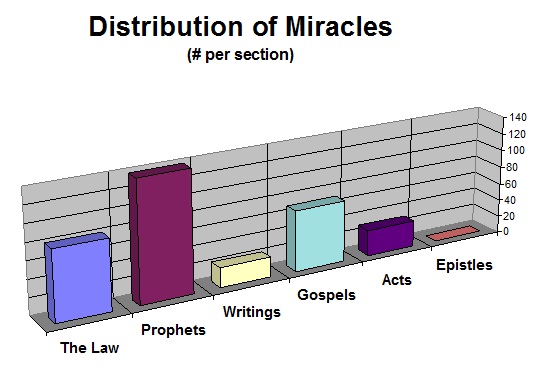
Sections of the Bible differ in how commonly they record miracles. But there is one thread that runs consistently throughout:
Miracles foster unbelief.
God’s great miracles through Moses filled Egypt with undeniable evidence for the God of Israel (Ex. 9:27). Yet neither the Bible nor history records Egyptian repentance, only good riddance (Ps. 105:38; Ex. 12:35-36; 14:25). Further and more dramatic, consider the effect of those tremendous miracles on Israel. God followed the 10 plagues (Ex. 7:14-12:30) done on behalf of Israel with the parting of the Red Sea (Ex. 14:21-22) and the drowning of the Egyptian army (Ex. 14:26-28). Then daily for 40 years God appeared to the entire nation as a column of smoke by day and a pillar of fire by night (Ex. 13:21-22; Num. 14:14; Neh. 9:12; Ps. 105:39). The Lord kept their clothes from wearing out (Deut. 8:4), produced water out of the Rock (Ex. 17:2-6), fed the people with angels food from heaven (Ex. 16:4-7) and brought meat on demand, literally filling their camp with quail (Num. 11:31-32; Ps. 105:40).
Yet with all this, virtually the entire nation rejected God:
For who, having heard, rebelled? Indeed, was it not all who came out of Egypt, led by Moses? … Was it not with those who sinned, whose corpses fell in the wilderness? Heb. 3:16-17
…and in the wilderness forty years, until all the generation… was gone. Num. 32:13
Jesus did great miracles and crowds followed Him, but mostly out of selfishness. Of thousands who received His miracles, few worshiped Him. Of 10 lepers healed, only one even said thanks (Luke 17:17). Generally, Christ’s miracles did not win over the crowds (Mat. 8:34; 11:20; 13:58; Mark 15:8-15; Luke 4:23-28; 8:37; 17:17; John 5:8-10; 10:25-39; 12:29-30). Even His own city rejected the miracle-working Messiah (Mark 6:4-6).
Confronted By Truth
Why would miracles lead to unbelief? Consider this. Ten-year-old Norman bickers with his 12-year-old brother Jack. “We’ll probably have left over spaghetti for lunch.” Jack says, “No we won’t. There’s none left, it’s all gone. We finished it last night.”
Norman: No, there’s some leftovers. Jack: You’re wrong, it’s all gone. Norman: No, there’s leftovers. Jack: Nope. We finished it. Norman: Did not. Jack: Did too. I saw mom put the rest in the garbage disposal. Norman: Do you like being wrong? Jack: I’m not wrong. You’re wrong. Norman: All right, I’ll just go in there and prove it.
Norman comes out of the house with a serving bowl half filled with leftover spaghetti. He shows it to his brother.
Question: Is Jack happy that he now knows the truth? Answer: No. Actually, Jack is angry. Why? Norman proved him wrong!
People do not like the truth shoved into their faces. Jack may now know that there is leftover spaghetti but he resents his brother for proving the point. These boys quarreled over a minor issue. What is the reaction when the issue becomes more significant?
Often the more serious the issue, the more a man resents those who prove him wrong. Evangelism sees the ultimate application of this principle. He who rejects God is not typically eager for correction. When someone’s heart is hardened against God, a miracle shoves the truth in his face. His mind cannot deny God but his heart can resist. Thus countless witnesses of the miraculous have refused to acquiesce.
In which three cities did Jesus perform most of His miracles and what was the corporate response of those cities to His works?
Then He began to rebuke the cities in which most of His mighty works had been done, because they did not repent… Chorazin… Bethsaida… Capernaum… Mat. 11:20-23
Jesus’ miracles benefited the masses, yet entire cities rejected Him. His very reputation for doing miracles hurt His own ministry:
So He came to Nazareth, where He had been brought up. … And they said… “Whatever we have heard done in Capernaum, do also here in Your country.” … So all those in the synagogue, when they heard these things, were filled with wrath, and rose up and thrust Him out of the city; and they led Him… that they might throw Him down over the cliff. Luke 4:16-29
In the city where Jesus did His first miracle the people’s constant requests discouraged Him. For that reason He chided Cana for their constant need to “see signs and wonders” (John 4:48). In another region, Christ’s extraordinary reputation and His visible authority over demons (Mat. 8:28-33) did little to produce repentance:
The Lord did many miracles in Jerusalem and it’s suburbs. Yet even in Jerusalem the crowds were not won over.
For good reasons God determined to provide signs and wonders for and through Israel. Yet even He tired of their demand for service. It’s like bratty kids who want more and more, and no matter how much a parent does for them, they just demand more. It gets so that the parent is restrained from doing the good he would have wanted to do, because of the emotional weakness and immaturity of his children. The parent, for the child’s own good, wants the child to love him, not for gifts but for himself.
Then the Pharisees came out and began to dispute with Him, seeking from Him a sign from heaven, testing Him. But He sighed deeply in His spirit, and said, “Why does this generation seek a sign?” Mark 8:11-12
Miracles did not effectively teach the crowds for their outward manifestation of faith did not persuade Jesus:
Most assuredly, I say to you, you seek Me, not because you [believe], but because you ate of the loaves and were filled. John 6:26
The Rich Kid
The rich kid expects special treatment. The rules should not apply to him. But his wise earthly father, though he has wealth and power, does not comply. How much more will God, our heavenly Father, encourage His children to live by the rules, without special exceptions?
What happens if the rich kid has an imprudent father? His son wants special treatment and gets it. The rules are bent for him, over and over and over. He does not learn the lesson of his failures here on earth. He is shielded from the consequences of his actions. Obviously this hurts the son, but what of the onlookers? What do neighbors think of the powerful dad who pulls strings so his kid gets away with things other kids cannot get away with? What do schoolmates think of the rich kid’s privilege? Does it warm their hearts? Are they drawn to respect dad and admire the son?
Breaking the rules for favored sons makes for difficult relationships. Thus, when God performs miracles for some, He complicates the conversion of others. He knows that. He filled a book with the evidence. He suffers anguish over the selfishness of His children. They ask and ask, mindless of the repercussions. How many perverse generations have demanded special favors of Him? Jesus said:
An evil and adulterous generation seeks after a sign… Mat. 12:39
Conspicuous by their Absence
Why do the Epistles have a scarcity of miracles? God miraculously healed every sick person introduced in the Gospels and Acts, but none in the Epistles. For example, Paul’s said, “Trophimus I have left in Miletus sick.” (2 Tim. 4:20).
Paul’s first letter to his good friend shows that Timothy had a reputation as a physically unhealthy person who suffered from “frequent infirmities.”
…use a little wine for your stomach’s sake and for your frequent infirmities. 1 Tim. 5:23
The Epistles tell of no specific miracles. Paul knew of Timothy’s continuing health problems. This means that Paul himself did not heal Timothy of this persistent problem. Further, of course, neither could Timothy nor any of the believers around him heal this ailment. Moreover, Paul does not even instruct Timothy to seek deliverance by praying for healing or anointing with oil.
Notice that Christians who pray for God to miraculously fix their cars only pray for repairs they cannot see with their eyes. If a car does not start, some believers will ask God to fix it rather than asking Him for wisdom in the situation. However, believers never ever pray for a repair of something visibly wrong with the car. For example, Christians never pray and ask God to supernaturally fix a flat tire. Why? If a knob is broken off or a windshield is busted out, Christians do not ask God to fix those things. Why? Because they know, deep within, even if they have a hard time admitting it, that God will not fix those things no matter how much faith they have. However, a mechanical problem that they cannot see presents a blind faith opportunity to deceive themselves. The uncertainty that goes with hidden problems leaves enough chance that the car just might start on the next attempt (as cars so often do). So, Christians claim a miracle when the car starts on the next try.
Christians should admit that they do not possess the physical redemption of their earthly bodies. For if they did possess that redemption, then they would not long for it. So remember to glorify God in trials and difficulties because that is when His power will shine brightest.
…the sufferings of this present time are not worthy to be compared with the glory which shall be revealed in us… For… we ourselves groan within ourselves, eagerly waiting for the adoption, the redemption of our body. For we were saved in this hope, but hope that is seen is not hope; for why does one still hope for what he sees? But if we hope for what we do not see, then we eagerly wait for it… Rom. 8:17, 22-25
By Bob Enyart Pastor, Denver Bible Church Talk show host, KGOV.com
You may want to read Bob’s best-selling book, The Plot or listen to Bob teach through The Plot. Chapter 10 of this work provides a visual analysis of the 343 miracles in Scripture and the book gives an overview of the entire Bible. So you can get The Plot online or by calling 1-800-8Enyart and online you can see more of Bob Enyart’s Bible resources or write to us at BEL, PO Box 583, Arvada, CO 80001.
Where am I today, I wish that I knew. Looking around, there is no sign of you. I don’t remember one jump or one leap. Just quiet steps away from your lead.
-”Reasons Why” by Nickel Creek
If you live your life looking for some sign from God that never seems to come, it may be easy to relate to the song above.
God is there. He always hears his children! However, on the darkest of nights, when the silence is deafening, it can make one wonder, “where is God?”
I have a beautiful infant son. I take the night shift, feeding him and changing him. On one particular night, I sat on a couch with him in my arms feeding him a bottle. As I looked down on him, I wondered how much this young child was able to understand about who was feeding him. How much can an infant comprehend about me?
I tell my hungry son that food is on the way but he cannot understand that I am standing at a sink, mixing a bottle, putting on a lid, and looking for a bib. Sometimes he can’t see what I am doing, and he cries as though I am doing nothing. If only he knew how busy I was for him, he would never cry again!
I think God works in ways that are not visible to us because He is on a different level. He is the parent, we are the children. This means there will be times when we will not recognize his involvement. If this lack of insight produces doubt, we should cling to our faith as the insight we need.
God’s works are real regardless of our inability to know the hows, whys, and wheres. Whether we see it or not, he is there. We don’t need a sign as evidence to know this. Faith is our evidence, yet faith is a choice sometimes. If he said that we are important to him, we can make up our minds to accept that it is true and have faith.
Listen to these comforting words of Christ
Look at the birds in the sky: They do not sow, or reap, or gather into barns, yet your heavenly Father feeds them. Aren’t you more valuable than they are? And which of you by worrying can add even one hour to his life? Why do you worry about clothing? Think about how the flowers of the field grow; they do not work or spin. Yet I tell you that not even Solomon in all his glory was clothed like one of these! And if this is how God clothes the wild grass, which is here today and tomorrow is tossed into the fire to heat the oven, won’t he clothe you even more, you people of little faith? So then, don’t worry saying, ‘What will we eat?’ or ‘What will we drink?’ or ‘What will we wear?’ For the unconverted pursue these things, and your heavenly Father knows that you need them. But above all pursue his kingdom and righteousness, and all these things will be given to you as well. So then, do not worry about tomorrow, for tomorrow will worry about itself. Today has enough trouble of its own.
Matthew 6:26-34 NET
He couldn’t be more clear. He is there for you! Have faith, my friend, in God’s love for you.
If you have ever prayed for something important, only to find what you prayed about didn’t come to pass, you understand the despair that comes from an unanswered prayer.
People pray for many different things: a happy marriage, for healing, for success, and so on. Yet it turns out those very people can have bad marriages, die from diseases, and fail at their endeavors.
Christians try to reason why this is so. Some believe that somehow, the prayer was answered. They say the possible answers are “Yes,” “No,” and “Wait.” While technically one of these three words can qualify as an “answer” to most requests, it does not truly address the question “Why didn’t God give me what I asked for.”
Others say that it wasn’t answered because it “wasn’t for the best,” or it “wasn’t his will.” These answers are problematic too. We do understand God’s will enough to say this is true. Furthermore, there are prayers with answers that would fit into God’s will, yet they too are unanswered.
For example, if you pray for someone to be saved, and that person never is saved, that unanswered prayer defiantly wasn’t for the best (as far as that individual was concerned). It also wasn’t God’s will that the individual not be saved:
2 Peter 3:9
The Lord is …. not willing that any should perish but that all should come to repentance.
The real reasons God doesn’t answer prayers according to their requests is not found in these simple “Yes, No, Wait, God’s will” clichés. Scripture doesn’t use these answers, yet we still use these to offer comfort. However, these clichés can silence the mouth of a person who needs understanding. They even drive others to doubt God is even there.
The real reasons are more practical. Freewill is a key element that is involved in whether or not God will actually answer a prayer. If a prayer involves manipulating someone’s freewill, that prayer will not be answered. How would you feel if someone prayed God make you do something you didn’t want to do, and God forced you to do it anyway?
Some prayers are not up to God to answers. For example, if someone prays for a happy marriage, God isn’t going to brainwash his or her spouse to constantly be pleasing. The responsibility to make a happy home must be fulfilled by the people who live in it.
A marriage is a complex relationship between a man and a woman, two different people with conflicting interests at times. Instead of asking God to magically make the two happy, they should ask God for the wisdom to make each other happy.
If a marriage falls apart, there is little God can do to guarantee the marriage can be restored because it is up to the couple to keep it together, not God. He will not brainwash someone into staying married to another when they would rather leave.
God respects freewill. Prayers that trample on freewill are not likely to be answered. However, God is a great gardner. He can plant ideas and nourish them, but ultimately, it the person who allows God’s seed to take root. You could pray that God impress a thought on someone’s heart and he might do it. But in the end, it is the person’s decision to allow God to lead.
Praying for success is another area that freewill will be a factor. If someone prays for his or her church to be a success, God could help make the church fruitful, but he will not make someone eat of its fruit. If only a few people join a church, it isn’t that God didn’t want to answer the prayer. It is more likely that God wanted to use your church, but the people who attend used their freewill and made the church unfruitful.
We live in a very complex world. Every person has their own opinions, likes, desires, strengths, and freewill. No two people are the same, and there is constantly interaction between people. How a person acts and responds represents his or her own will at play.
Success can depend on the right people being available, the right ideas coming from the right minds, and many other factors all involving freewill and a willingness to hear God’s advice.
I hope you are beginning to see some of the issues that affect the answers to prayers. It simply doesn’t always come down to God’s will. It also isn’t always “Yes No or Wait.” Sometimes it is “Yes, but you have to work at it too.” Sometimes it is “No, but it might happen anyway.”
God isn’t micromanaging his creation. If he wanted to do that, there would be no freewill. So when you pray, do not think God is pulling everyone’s strings to make whatever he wants to happen come about.
But what about prayers involving healing? This is a touchy issue. Some people believe God healed them of a disease. Others pray for years and never are healed. Sometimes the people who need healing are innocent children. Both good and bad people get sick, pray, and people from both groups experience recovery at the same rate.
What is going on? Is God healing some but not others? Why not heal a child? Why do rich people live healthier lives than a good poor person in spite of prayer? In scripture, healing of sickness was instant. Why does it always take time, doctors, and drugs to heal today?
Before I continue, I must say that for the Christian, the answer to this prayer has already been answered in essence. In heaven, a person receives a perfect, healthy body. So ultimately, the answer is yes, God will heal a Christian.
While that is true, when we ask God to heal someone, we almost always mean now. Not in heaven, now. Many people never see an earthly miraculous healing.
One reason offered is that God has decided to use miracles less often today. Some even say no miraculous healing happens today. The reason God has slowed down miracle occurrence has to do with saving souls. It is said that miracles actually detour people from being saved.
Your instinct might cause you to believe a healing would be a sign to an unbeliever. It isn’t. Think about it… most unbelievers try to write off miracles with skepticism. A miracle is not a guaranteed ticket to convert someone. If you recall from scripture, the great healer himself, Jesus Christ, was crucified. He was crucified by the very people he healed. Jesus preformed miracles in their very sight, yet they didn’t believe.
A crowd of people doubt a voice from heaven was real:
John 12:28b
….Then a voice came from heaven, saying, “I have both glorified it and will glorify it again.” 29 Therefore the people who stood by and heard it said that it had thundered. Others said, “An angel has spoken to Him.”
One example of people rebuking Jesus for healing on a Saturday.
Luke 13:14 But the ruler of the synagogue answered with indignation, because Jesus had healed on the Sabbath; and he said to the crowd, “There are six days on which men ought to work; therefore come and be healed on them, and not on the Sabbath day.”
A blind man is excommunicated after being healed
John 9:13-34
Believe it or not, Christianity is stronger today with fewer signs and wonders than it was when it first began, when signs and wonders were common.
If God doesn’t heal someone, even a child, the reason could be because not healing leads to more souls for the kingdom. Even though you care for the person who needs healed, God cares for the souls of everyone alive. Our bodies wear out, and die, but our souls live on. If miracles turned people off in Jesus day, the same would likely happen today.
It may be difficult to watch someone suffer, but the good news is their suffering is temporary if they are a Christian. If God healed them, and it caused 10 people to fall away, should God heal one person’s mortal body and forsake the 10 people’s immortal souls?
Things are differrent from when Jesus told his apostles to heal everyone.
Whatever God doesn’t do, the answer always comes back to love for you, and the world of other people around you. If you want to pray for someone who is sick, pray that God be with that person’s doctors. Pray for that person’s attitude, and for peace to find their worried mind. God can answer these prayers.
It is God’s will to save as many who will come. He will always answer with a, “Yes,” to anyone who wishes to be saved. He is faithful to give wisdom for those who pray for it. Prayer is for more than requests, it is also to talk to God about anything. You can ask for forgiveness, peace, and alertness. God can help you become a better person when you are willing.
Intelligent Design is a theory supported by many Christian to point at God as the creator of all that exists.
Intelligent Design argues that the complexity of the universe could not have originated by chance and required an intelligent designer, who is unnamed, to set things in motion.
Some argue Intelligent Design is not just a theory. Instead it is an attempt to teach religion in the classroom because God is usually named as the designer.
This article will try to determine if Intelligent Design is science that should be more recognized.
The Problem With Intelligent Design
The United States National Academy of Sciences (USNAS) states that Intelligent Design is not science. “Creationism, intelligent design, and other claims of supernatural intervention in the origin of life or of species are not science because they are not testable by the methods of science.”
How can we test Creationism? Our current technology and knowledge of the universe provides us with no way to test God. So far, Intelligent Design’s leading proponents have not put forth a test for the theory to satisfy the requirement pointed out by the USNAS.
Intelligent Design is also criticized because it is said to make no scientific predictions.
What is Science?
Ultimately, science is the pursuit of knowledge or understanding on any given aspect of the workings universe and or society in which we live. The way most scientists go about verifying the scientific validity of understanding is by testing it with the scientific method.
We should understand the scientific method is only as good as the tests we are capable of conducting. The better technology the more capable we are at examining and testing our scientific understanding.
Every year science presents us with studies that challenge the past’s understandings. As it turns out, what we knew yesterday is very different from today. What we think is true today may be different tomorrow.
This means scientific truth is largely undiscovered. Science is still evolving! We can look through history and see this evolution take place.
Lets turn the calendar back 2,500 years to Ancient Greece. The cutting edge science of the day stated everything was derived from four elements: fire, earth, water and air.
During the Middle Ages this changed. The scientific community was comprised of alchemist. As you know, alchemist tried to create gold from other metals. Alchemist believed everything was made of tiny hooks.
Today we think atoms make up the universe. As you can see, scientific understanding of mater has evolved from four elements, to tiny hooks, to atoms. Science is still evolving.
Will our scientific understanding be like that of our ancestors? Will our children wonder why we believed in Atoms? The answer is, “Yes.”
It is already happening. Atomic theory is being challenged by something called String Theory. String Theory claims everything is made of tiny strings. Some scientists expect String Theory to prove to be superior to atomic theory.
Think about it. If string theory proves to be true, many of those chemistry tests you studied so hard for in high school have been for nothing. The understanding of basic elements may be happening again, right before our eyes.
As the history of scientific understanding shows us time and time again, the pursuit of knowledge is an illusive one. It is foolish to believe we fully understand the universe.
Even after using the “scientific method” we find what we think we know about the world is not even close. The more we test something, the more we find out we don’t really get it.
The reason our quest for knowledge via testing data falls short is because we do not have all the data to perform a proper test, nor the technology to perform it. Even if we had more data, the tests would become more complex requiring more technology.
This means much of science becomes “guess work”. The scientific community, in essence, votes on the “best guess”. This isn’t necessarily a bad thing because if science didn’t take guesses, we would get nowhere.
At the very least this should show that science, even with tests, is hardly 100% reliable knowledge. The best anyone can do for understanding origins is make a good guess and hope one day science will provide a way to test it.
This realization should allow scientists to be more open to a theory like Intelligent Design. After all, they do not know everything, and what they think we know is an educated guess in the end.
How can scientists be so sure Intelligent Design is not true? If it truly isn’t testable, is it automatically false? How can science be so quick to dismiss it?
Censorship of Intelligent Design
Dr. Eugenie Scott and other atheist have pushed an aggressive campaign against allowing Intelligent Design in the classroom. With USNAS’s criticism they have systematically made it illegal for a school system to teach Intelligent Design.
If you have time, you should educate yourself on the motivation behind this censorship by watching the following video:
If you do not have time to watch the video, allow me to summarize. It states that Intelligent Design is not science. It is a religious movement that began as “Creationism,” but merely changed its name to Intelligent Design.
The organization has been very successful at keeping it out of schools on this premise. Now it is considered unconstitutional to teach in K-12 classrooms. Courts punish school systems with heavy fines when they attempt to teach Intelligent Design.
The secular world frowns on Intelligent Design. Mostly, they feel it is another way to “pollute” science with religious ideas. It is not seen as a genuine attempt to explain origins, but rather an excuse to have “Sunday school” in the name of science.
Intelligent Design historically has been used as a reason to change curriculum in public schools, so I hardly blame atheists for being skeptical about the motive behind the theory. However, I do find fault with anyone who would dismiss a theory solely because its proponents have an agenda.
This dismissal based on agenda has gone beyond censorship of Intelligent Design in the classroom and has hindered the scientific community as a whole from considering the validity of the theory.
Creation science in general, as a new field, has always been under fire and receives little aid for research. And that shortcoming makes it appear to have no hope for scientific acceptance.
It is as if some scientific organizations fear some aspect of the theory might prove to be scientific. If that happened, religion would suddenly have a place with science, and therefore a place in schools.
If you watch the video, you can see how Intelligent Design is heavily mocked. It is mostly mocked because it is seen as an excuse to have church at school with little scientific support. As a result no scientist will step up to explore Intelligent Design even for genuine science purposes.
Now, Intelligent Design is at a huge disadvantage. Most scientist think it is just an agenda, so no scientists will explore it. Other scientists have an agenda of keeping religion and science separate, so they dislike Intelligent Design because its advocates want to unite the two.
All this makes the scientific community highly skeptical of the few brave scientists who attempt to study it. As a result, the theory makes no progress. As a result, the lack of progress appears to mean lack of validity, and its critics say that it is pseudo science.
Is Science only a Test?
Atheists say Intelligent Design is pseudo science because it cannot be tested. We can’t experiment on it. Let’s put this in perspective.
If we lived 2,000 years ago it would have been impossible to prove the existence of atoms with the technology of the day. Pretend a group believed in Atomic Theory that long ago. Now, lets say the scientist of that day apply the same standards the USNAS puts on Intelligent Design.
If they did that, the leading scientists of the day would be forced to dismiss the idea! “You can’t test the idea, so it is not scientific.” Would the Atomic Theory be labeled “pseudo science,” because no test existed to support the idea?
As we know, the Atomic theory has lead to amazing technologies today. Everything from the plastic in our phones to the steal in our buildings comes from the understanding of the chemistry, which utilizes the Atomic Theory.
If such a groundbreaking theory were available to the scientists of old, technology would have had the chance to advance 2,000 years! But with no test to prove it, Atomic theory would have been tossed out with the trash. No school would be allowed to teach it, no respected establishment would remain credited if it promoted this idea.
Should science be so rigid that it cannot consider something unless the scientific method can be applied then and there? If it does, it must throw out other theories until all are test worthy.
Theories
Our access to knowledge and technological abilities sometimes limits our ability to perform conclusive scientific tests. Because we cannot test everything, there is quite a bit of truth about our world that remains to be acknowledged by scientists. For that reasons scientists have theories.
Theories are like educated guess for an answer to our questions about the universe, ideally based upon reliable data. A theory is considered to be sound when it takes into consideration much of the reliable data available.
If we cannot test theories yet, why are they considered scientific? When someone defines a theory is the way I did, it looks like the scientific community is using a double standard when it comes to Intelligent Design.
Theories are considered scientific because they might be proven right, or wrong, given that future information and technology provides us with a way to examine it. Scientific theories are ideas that are plausible by modern understanding yet unproven because of the limitation to test it directly.
The reason the title “The Big Bang” always has the word “Theory” tacked at the end of it is because we cannot test it directly to prove it right or wrong. If we could test the theory we would know if its claims were true or not.
The same can be said for the Theory of Evolution as the Origin of the Species. We can’t directly test it to prove it right or wrong.
However, what both of these theories are said to have is data based on observation that implies they are plausible answers to the question, “How did we get here?”
What about Intelligent Design? I do not often see the word “Theory” attached, but it is a theory. Because of technical limitations we cannot test it, just like the other theories. Is it a plausible theory? Is it based on observation or reliable data?
I would argue that it could be. Intelligent Design hypothesizes that complex systems of life can only have originated from an intelligent designer; random events are insufficient to result in even the simplest forms of life.
With our current technology we can measure how complex life is and through experimentation we can determine how difficult life is to create. We can then speculate how capable natural processes with no intelligence are at producing life.
A group of scientists is already working on creating life in a lab. They expect to create a single cell organism by the year 2017. The task is extremely complex; they had to get a head start, using fatty acids, to create the cell membrane (fatty acids that came from organisms that are already living). They claim it will be a huge achievement to keep it alive for more than an hour. (creating life)
If they can create life, the next question will be “Can this process be reproduced in nature with no intelligent intervention?”
I will not attempt to answer these questions, but it seems unlikely. Whatever the answer, the core of the Intelligent Design Theory does seem testable in the near future. What is not testable (yet) is trying to figure out “who” the designer is.
For whatever reason, the above “test” has not been suggested, or is not worthy of the scientific community’s ear.
Predictions
Predictions are an important part of the scientific method. They are used as a part of the experiment to validate a theory. Some in the scientific community claim Intelligent Design makes no predictions.
I do not believe this to be so. One prediction stated in the theory is that life will prove to be to complex to originate from natural/random circumstances.
Another prediction, while not widely discussed in science, is that if the designer created once he could do it again. We could predict encountering or witnessing a new creation at some point in the future.
Dangers of Intelligent Design for the Faithful
Did you know some priests in the Catholic Church actually supported the Big Bang Theory at first? That is because at the time scientists didn’t believe the universe had a beginning. The priests reasoned that if the church had a scientific theory that proved the universe had a beginning, we might be able to prove God started it.
Yet, the support backfired. Now the Big Bang Theory is supported by scientists, as hoped, but instead is used by many as reasons to doubt God. Why? Because the Big Bang isn’t in scripture.
The same could happen with Intelligent Design. Note that when you are reading news about Intelligent Design, notice how when the Christians are asked, “Whom is the designer according the theory,” they never answer, “God.”
This is because Intelligent Design is not really a theory that proves God exists. It can show us how something smart created us. Therefore, it could backfire in a big way.
Intelligent Design, by itself, fails to debunk the Theory of Evolution of the Species. It is not an alternative to Evolution, instead it could be considered as the cause of Evolution. The unnamed designer might be viewed by the scientific community as the one who initiated the first single cell life that would eventually evolve.
While Intelligent Design is a step towards proving God is there, it will not be the final destination to prove God created us as described in Genesis.
Conclusion
Science has yet to lead us to full understanding of the universe. Therefore, we cannot automatically remove God from origins of the universe and life, even if it has religious implications.
The criticism that the Theory of Intelligent Design is not science is unfounded. It hypothesizes that an intelligent creator as the origin of life. It predicts only intelligence could initiate life because of its complexities. It predicts natural/random events are insufficient for the creation of life. It predicts the chance of the “Intelligent Designer” creating again.
We can test many of these claims by making life ourselves. Upon understanding how complex it is to make life we can learn how likely such requirements occur be in nature. If those requirements do not or cannot occur together in nature, we will have proven the second prediction. We can also wait to see if the creator creates again, or search for evidence has already done so.
The areas we cannot test do not disqualify it from being considered science. It simply means, like any other inconclusive hypothesis, that we have a scientific theory.