Category: Prayer

  • Miracle Dynamics

    Sections of the Bible differ in how commonly they record miracles. But there is one thread that runs consistently throughout:

    Miracles foster unbelief.

    God’s great miracles through Moses filled Egypt with undeniable evidence for the God of Israel (Ex. 9:27). Yet neither the Bible nor history records Egyptian repentance, only good riddance (Ps. 105:38; Ex. 12:35-36; 14:25). Further and more dramatic, consider the effect of those tremendous miracles on Israel. God followed the 10 plagues (Ex. 7:14-12:30) done on behalf of Israel with the parting of the Red Sea (Ex. 14:21-22) and the drowning of the Egyptian army (Ex. 14:26-28). Then daily for 40 years God appeared to the entire nation as a column of smoke by day and a pillar of fire by night (Ex. 13:21-22; Num. 14:14; Neh. 9:12; Ps. 105:39). The Lord kept their clothes from wearing out (Deut. 8:4), produced water out of the Rock (Ex. 17:2-6), fed the people with angels food from heaven (Ex. 16:4-7) and brought meat on demand, literally filling their camp with quail (Num. 11:31-32; Ps. 105:40).

    For more Bible Related articles visit kgov.com

    Yet with all this, virtually the entire nation rejected God:

    For who, having heard, rebelled? Indeed, was it not all who came out of Egypt, led by Moses? … Was it not with those who sinned, whose corpses fell in the wilderness? Heb. 3:16-17

    …and in the wilderness forty years, until all the generation… was gone. Num. 32:13

    Jesus did great miracles and crowds followed Him, but mostly out of selfishness. Of thousands who received His miracles, few worshiped Him. Of 10 lepers healed, only one even said thanks (Luke 17:17). Generally, Christ’s miracles did not win over the crowds (Mat. 8:34; 11:20; 13:58; Mark 15:8-15; Luke 4:23-28; 8:37; 17:17; John 5:8-10; 10:25-39; 12:29-30). Even His own city rejected the miracle-working Messiah (Mark 6:4-6).

    Confronted By Truth

    Why would miracles lead to unbelief? Con­sider this. Ten-year-old Norman bickers with his 12-year-old brother Jack. “We’ll probably have left over spaghetti for lunch.” Jack says, “No we won’t. There’s none left, it’s all gone. We finished it last night.”

    Norman: No, there’s some leftovers.
    Jack: You’re wrong, it’s all gone.
    Norman: No, there’s leftovers.
    Jack: Nope. We finished it.
    Norman: Did not.
    Jack: Did too. I saw mom put the rest in the garbage disposal. Norman: Do you like being wrong?
    Jack: I’m not wrong. You’re wrong.
    Norman: All right, I’ll just go in there and prove it.

    Norman comes out of the house with a serving bowl half filled with leftover spaghetti. He shows it to his brother.

    Question: Is Jack happy that he now knows the truth? Answer: No. Actually, Jack is angry. Why? Norman proved him wrong!

    People do not like the truth shoved into their faces. Jack may now know that there is leftover spaghetti but he resents his brother for proving the point. These boys quarreled over a minor issue. What is the reaction when the issue becomes more significant?

    Often the more serious the issue, the more a man resents those who prove him wrong. Evangelism sees the ultimate application of this principle. He who rejects God is not typically eager for correction. When someone’s heart is hardened against God, a miracle shoves the truth in his face. His mind cannot deny God but his heart can resist. Thus countless witnesses of the miraculous have refused to acquiesce.

    In which three cities did Jesus perform most of His miracles and what was the corporate response of those cities to His works?

    Then He began to rebuke the cities in which most of His mighty works had been done, because they did not repent… Chorazin… Bethsaida… Capernaum… Mat. 11:20-23

    Jesus’ miracles benefited the masses, yet entire cities rejected Him. His very reputation for doing miracles hurt His own ministry:

    So He came to Nazareth, where He had been brought up. … And they said… “Whatever we have heard done in Capernaum, do also here in Your country.” … So all those in the synagogue, when they heard these things, were filled with wrath, and rose up and thrust Him out of the city; and they led Him… that they might throw Him down over the cliff. Luke 4:16-29

    In the city where Jesus did His first miracle the people’s constant requests discouraged Him. For that reason He chided Cana for their constant need to “see signs and wonders” (John 4:48). In another region, Christ’s extraordinary reputation and His visible authority over demons (Mat. 8:28-33) did little to produce repentance:

    The Lord did many miracles in Jerusalem and it’s suburbs. Yet even in Jerusalem the crowds were not won over.

    For good reasons God determined to provide signs and wonders for and through Israel. Yet even He tired of their demand for service. It’s like bratty kids who want more and more, and no matter how much a parent does for them, they just demand more. It gets so that the parent is restrained from doing the good he would have wanted to do, because of the emotional weakness and immaturity of his children. The parent, for the child’s own good, wants the child to love him, not for gifts but for himself.

    Then the Pharisees came out and began to dispute with Him, seeking from Him a sign from heaven, testing Him. But He sighed deeply in His spirit, and said, “Why does this genera­tion seek a sign?” Mark 8:11-12

    Miracles did not effectively teach the crowds for their outward manifestation of faith did not persuade Jesus:

    Most assuredly, I say to you, you seek Me, not because you [believe], but because you ate of the loaves and were filled. John 6:26

    The Rich Kid

    The rich kid expects special treatment. The rules should not apply to him. But his wise earthly father, though he has wealth and power, does not comply. How much more will God, our heavenly Father, encourage His children to live by the rules, without special exceptions?

    What happens if the rich kid has an imprudent father? His son wants special treatment and gets it. The rules are bent for him, over and over and over. He does not learn the lesson of his failures here on earth. He is shielded from the consequences of his actions. Obviously this hurts the son, but what of the onlookers? What do neighbors think of the powerful dad who pulls strings so his kid gets away with things other kids cannot get away with? What do schoolmates think of the rich kid’s privilege? Does it warm their hearts? Are they drawn to respect dad and admire the son?

    Breaking the rules for favored sons makes for difficult relationships. Thus, when God performs miracles for some, He complicates the conversion of others. He knows that. He filled a book with the evidence. He suffers anguish over the selfishness of His children. They ask and ask, mindless of the repercus­sions. How many perverse generations have demanded special favors of Him? Jesus said:

    An evil and adulterous generation seeks after a sign… Mat. 12:39

    Conspicuous by their Absence

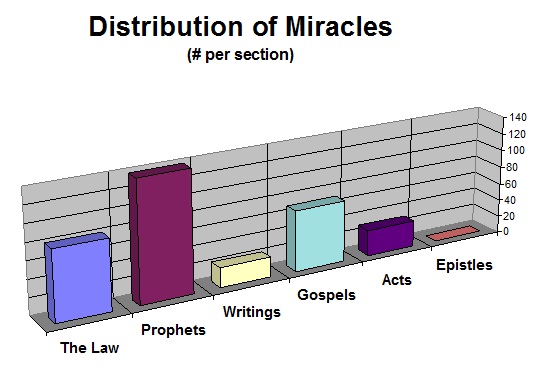
    Why do the Epistles have a scarcity of miracles? God miraculously healed every sick person introduced in the Gospels and Acts, but none in the Epistles. For example, Paul’s said, “Trophimus I have left in Miletus sick.” (2 Tim. 4:20).

    Distribution of miracles throughout the Scriptures

    Paul’s first letter to his good friend shows that Timothy had a reputation as a physically unhealthy person who suffered from “frequent infirmities.”

    …use a little wine for your stomach’s sake and for your frequent infirmities. 1 Tim. 5:23

    The Epistles tell of no specific miracles. Paul knew of Timothy’s continuing health problems. This means that Paul himself did not heal Timothy of this persistent problem. Further, of course, neither could Timothy nor any of the believers around him heal this ailment. Moreover, Paul does not even instruct Timothy to seek deliverance by praying for healing or anointing with oil.

    Notice that Christians who pray for God to miraculously fix their cars only pray for repairs they cannot see with their eyes. If a car does not start, some believers will ask God to fix it rather than asking Him for wisdom in the situation. However, believers never ever pray for a repair of something visibly wrong with the car. For example, Christians never pray and ask God to supernaturally fix a flat tire. Why? If a knob is broken off or a windshield is busted out, Christians do not ask God to fix those things. Why? Because they know, deep within, even if they have a hard time admitting it, that God will not fix those things no matter how much faith they have. However, a mechanical problem that they cannot see presents a blind faith opportunity to deceive themselves. The uncertainty that goes with hidden problems leaves enough chance that the car just might start on the next attempt (as cars so often do). So, Christians claim a miracle when the car starts on the next try.

    Christians should admit that they do not possess the physical redemption of their earthly bodies. For if they did possess that redemption, then they would not long for it. So remember to glorify God in trials and difficulties because that is when His power will shine brightest.

    …the sufferings of this present time are not worthy to be compared with the glory which shall be revealed in us… For… we ourselves groan within ourselves, eagerly waiting for the adoption, the redemption of our body. For we were saved in this hope, but hope that is seen is not hope; for why does one still hope for what he sees? But if we hope for what we do not see, then we eagerly wait for it… Rom. 8:17, 22-25

    By Bob Enyart
    Pastor, Denver Bible Church
    Talk show host, KGOV.com

    You may want to read Bob’s best-selling book, The Plot or listen to Bob teach through The Plot. Chapter 10 of this work provides a visual analysis of the 343 miracles in Scripture and the book gives an overview of the entire Bible. So you can get The Plot online or by calling 1-800-8Enyart and online you can see more of Bob Enyart’s Bible resources or write to us at BEL, PO Box 583, Arvada, CO 80001.

  • Where is God?

    Where am I today, I wish that I knew. Looking around, there is no sign of you. I don’t remember one jump or one leap. Just quiet steps away from your lead.

    -”Reasons Why” by Nickel Creek

    If you live your life looking for some sign from God that never seems to come, it may be easy to relate to the song above.

    God is there. He always hears his children! However, on the darkest of nights, when the silence is deafening, it can make one wonder, “where is God?”

    I have a beautiful infant son. I take the night shift, feeding him and changing him. On one particular night, I sat on a couch with him in my arms feeding him a bottle. As I looked down on him, I wondered how much this young child was able to understand about who was feeding him. How much can an infant comprehend about me?

    I tell my hungry son that food is on the way but he cannot understand that I am standing at a sink, mixing a bottle, putting on a lid, and looking for a bib. Sometimes he can’t see what I am doing, and he cries as though I am doing nothing. If only he knew how busy I was for him, he would never cry again!

    I think God works in ways that are not visible to us because He is on a different level. He is the parent, we are the children. This means there will be times when we will not recognize his involvement. If this lack of insight produces doubt, we should cling to our faith as the insight we need.

    God’s works are real regardless of our inability to know the hows, whys, and wheres. Whether we see it or not, he is there. We don’t need a sign as evidence to know this. Faith is our evidence, yet faith is a choice sometimes. If he said that we are important to him, we can make up our minds to accept that it is true and have faith.

    Listen to these comforting words of Christ

    Look at the birds in the sky: They do not sow, or reap, or gather into barns, yet your heavenly Father feeds them. Aren’t you more valuable than they are? And which of you by worrying can add even one hour to his life? Why do you worry about clothing? Think about how the flowers of the field grow; they do not work or spin. Yet I tell you that not even Solomon in all his glory was clothed like one of these! And if this is how God clothes the wild grass, which is here today and tomorrow is tossed into the fire to heat the oven, won’t he clothe you even more, you people of little faith? So then, don’t worry saying, ‘What will we eat?’ or ‘What will we drink?’ or ‘What will we wear?’ For the unconverted pursue these things, and your heavenly Father knows that you need them. But above all pursue his kingdom and righteousness, and all these things will be given to you as well. So then, do not worry about tomorrow, for tomorrow will worry about itself. Today has enough trouble of its own.

    Matthew 6:26-34 NET

    He couldn’t be more clear. He is there for you! Have faith, my friend, in God’s love for you.

  • Unanswered Prayer

    If you have ever prayed for something important, only to find what you prayed about didn’t come to pass, you understand the despair that comes from an unanswered prayer.

    People pray for many different things: a happy marriage, for healing, for success, and so on. Yet it turns out those very people can have bad marriages, die from diseases, and fail at their endeavors.

    Christians try to reason why this is so. Some believe that somehow, the prayer was answered. They say the possible answers are “Yes,” “No,” and “Wait.” While technically one of these three words can qualify as an “answer” to most requests, it does not truly address the question “Why didn’t God give me what I asked for.”

    Others say that it wasn’t answered because it “wasn’t for the best,” or it “wasn’t his will.” These answers are problematic too. We do understand God’s will enough to say this is true. Furthermore, there are prayers with answers that would fit into God’s will, yet they too are unanswered.

    For example, if you pray for someone to be saved, and that person never is saved, that unanswered prayer defiantly wasn’t for the best (as far as that individual was concerned). It also wasn’t God’s will that the individual not be saved:

    2 Peter 3:9

    The Lord is …. not willing that any should perish but that all should come to repentance.

    The real reasons God doesn’t answer prayers according to their requests is not found in these simple “Yes, No, Wait, God’s will” clichés. Scripture doesn’t use these answers, yet we still use these to offer comfort. However, these clichés can silence the mouth of a person who needs understanding. They even drive others to doubt God is even there.

    The real reasons are more practical. Freewill is a key element that is involved in whether or not God will actually answer a prayer. If a prayer involves manipulating someone’s freewill, that prayer will not be answered. How would you feel if someone prayed God make you do something you didn’t want to do, and God forced you to do it anyway?

    Some prayers are not up to God to answers. For example, if someone prays for a happy marriage, God isn’t going to brainwash his or her spouse to constantly be pleasing. The responsibility to make a happy home must be fulfilled by the people who live in it.

    A marriage is a complex relationship between a man and a woman, two different people with conflicting interests at times. Instead of asking God to magically make the two happy, they should ask God for the wisdom to make each other happy.

    If a marriage falls apart, there is little God can do to guarantee the marriage can be restored because it is up to the couple to keep it together, not God. He will not brainwash someone into staying married to another when they would rather leave.

    God respects freewill. Prayers that trample on freewill are not likely to be answered. However, God is a great gardner. He can plant ideas and nourish them, but ultimately, it the person who allows God’s seed to take root. You could pray that God impress a thought on someone’s heart and he might do it. But in the end, it is the person’s decision to allow God to lead.

    Praying for success is another area that freewill will be a factor. If someone prays for his or her church to be a success, God could help make the church fruitful, but he will not make someone eat of its fruit. If only a few people join a church, it isn’t that God didn’t want to answer the prayer. It is more likely that God wanted to use your church, but the people who attend used their freewill and made the church unfruitful.

    We live in a very complex world. Every person has their own opinions, likes, desires, strengths, and freewill. No two people are the same, and there is constantly interaction between people. How a person acts and responds represents his or her own will at play.

    Success can depend on the right people being available, the right ideas coming from the right minds, and many other factors all involving freewill and a willingness to hear God’s advice.

    I hope you are beginning to see some of the issues that affect the answers to prayers. It simply doesn’t always come down to God’s will. It also isn’t always “Yes No or Wait.” Sometimes it is “Yes, but you have to work at it too.” Sometimes it is “No, but it might happen anyway.”

    God isn’t micromanaging his creation. If he wanted to do that, there would be no freewill. So when you pray, do not think God is pulling everyone’s strings to make whatever he wants to happen come about.

    But what about prayers involving healing? This is a touchy issue. Some people believe God healed them of a disease. Others pray for years and never are healed. Sometimes the people who need healing are innocent children. Both good and bad people get sick, pray, and people from both groups experience recovery at the same rate.

    What is going on? Is God healing some but not others? Why not heal a child? Why do rich people live healthier lives than a good poor person in spite of prayer? In scripture, healing of sickness was instant. Why does it always take time, doctors, and drugs to heal today?

    Before I continue, I must say that for the Christian, the answer to this prayer has already been answered in essence. In heaven, a person receives a perfect, healthy body. So ultimately, the answer is yes, God will heal a Christian.

    While that is true, when we ask God to heal someone, we almost always mean now. Not in heaven, now. Many people never see an earthly miraculous healing.

    One reason offered is that God has decided to use miracles less often today. Some even say no miraculous healing happens today. The reason God has slowed down miracle occurrence has to do with saving souls. It is said that miracles actually detour people from being saved.

    Your instinct might cause you to believe a healing would be a sign to an unbeliever. It isn’t. Think about it… most unbelievers try to write off miracles with skepticism. A miracle is not a guaranteed ticket to convert someone. If you recall from scripture, the great healer himself, Jesus Christ, was crucified. He was crucified by the very people he healed. Jesus preformed miracles in their very sight, yet they didn’t believe.

    A crowd of people doubt a voice from heaven was real:

    John 12:28b

    ….Then a voice came from heaven, saying, “I have both glorified it and will glorify it again.” 29 Therefore the people who stood by and heard it said that it had thundered. Others said, “An angel has spoken to Him.”

    One example of people rebuking Jesus for healing on a Saturday.

    Luke 13:14 But the ruler of the synagogue answered with indignation, because Jesus had healed on the Sabbath; and he said to the crowd, “There are six days on which men ought to work; therefore come and be healed on them, and not on the Sabbath day.”

    A blind man is excommunicated after being healed

    John 9:13-34

    Believe it or not, Christianity is stronger today with fewer signs and wonders than it was when it first began, when signs and wonders were common.

    If God doesn’t heal someone, even a child, the reason could be because not healing leads to more souls for the kingdom. Even though you care for the person who needs healed, God cares for the souls of everyone alive. Our bodies wear out, and die, but our souls live on. If miracles turned people off in Jesus day, the same would likely happen today.

    It may be difficult to watch someone suffer, but the good news is their suffering is temporary if they are a Christian. If God healed them, and it caused 10 people to fall away, should God heal one person’s mortal body and forsake the 10 people’s immortal souls?

    Things are differrent from when Jesus told his apostles to heal everyone.

    Whatever God doesn’t do, the answer always comes back to love for you, and the world of other people around you. If you want to pray for someone who is sick, pray that God be with that person’s doctors. Pray for that person’s attitude, and for peace to find their worried mind. God can answer these prayers.

    It is God’s will to save as many who will come. He will always answer with a, “Yes,” to anyone who wishes to be saved. He is faithful to give wisdom for those who pray for it. Prayer is for more than requests, it is also to talk to God about anything. You can ask for forgiveness, peace, and alertness. God can help you become a better person when you are willing.